
Every organization has a chain of command. A request moves from one department to another. Finance waits on Operations. Operations waits on HR. HR waits on Compliance. One decision often depends on another before work can move forward. It can be really slow if you ask me. But at least everyone is still working inside the same organization.
When every department moves to a different building
Now imagine if every department suddenly moved into a different building. Finance is across town. HR is somewhere else. Operations has another address. Compliance keeps its own records.
Every conversation now requires leaving one building to find another before work can continue. That isn't just inefficient but exhausting as well. For many home care agencies, that's exactly what daily operations have become. And it is not because their teams are disconnected but because their software is.
One agency, five platforms
The average home care agency today depends on multiple applications just to keep daily operations running.
One platform for scheduling.
Another for payroll.
Another for documentation.
Another for attendance.
Another for communication.
Sometimes even more for qualifications, invoices, reports, caregiver records, expenses, or compliance. Each application performs its own role well. The problem isn't what each application does. The problem is what happens between them.
What a software handoff actually is
Every time information has to move from one application to another, a software handoff is created. And every software handoff creates another opportunity for delays, duplication, mistakes, or manual work.
What happens after one completed visit
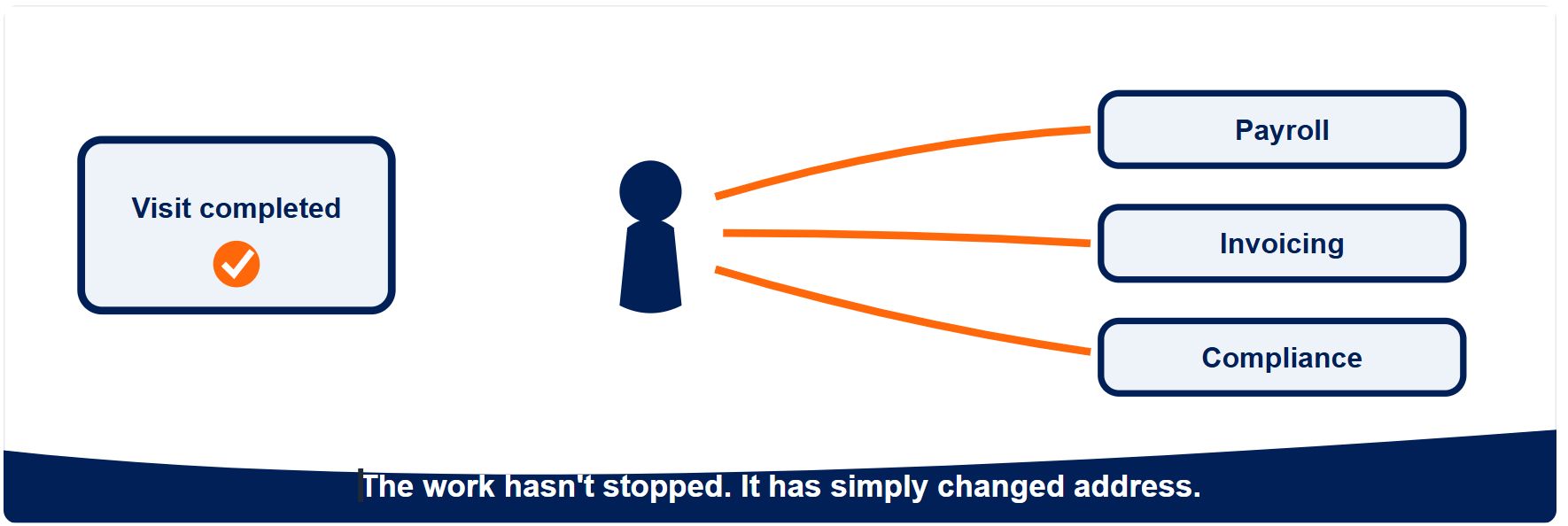
Think about what happens after a caregiver completes a visit. Attendance has been recorded. Now the information has to travel:
Payroll needs those hours.
Operations need to confirm the visit happened.
Documentation needs to be completed.
Finance needs the same information for invoicing.
Compliance needs to know whether qualifications are still valid.
Management needs accurate reports.
If each department relies on different software, the information rarely moves on its own. Someone has to move it. Usually an administrator. Or an operations manager. They're exporting spreadsheets. Copying information. Importing files. Comparing records. Approving timesheets. Following up on missing documentation. Checking whether one system matches another.
The agency hasn't stopped working. The work has simply shifted from caring for people to helping software communicate with other software.
The hidden cost of "another"
The hidden cost isn't just paying for the subscriptions. Although those monthly and annual payments certainly add up. It's paying for everything those subscriptions quietly demand.
Another login.
Another password.
Another onboarding session.
Another integration.
Another dashboard to learn.
Another place where information can become inconsistent.
Another system someone on the team has to monitor every single day.
Every application promises to save time. But when they don't work together, they often relocate the complexity instead of removing it.
The work still exists. It has simply changed address.
One connected workflow
This is why we built ShiftDove. Not to become another application that solves one operational problem while creating another. But to bring the essential parts of running a home care agency into one connected platform.
Imagine opening your laptop at the beginning of the day and, instead of deciding which application to open first, everything you need is already connected. Your staff records sit alongside their qualifications. Schedules update alongside attendance and timesheets. Messages stay connected to the people and shifts they relate to. Documents, invoices, reports, and client records all live within the same workflow instead of being scattered across different systems.
If a caregiver's shift changes, the relevant information flows through the platform instead of requiring someone to manually update multiple applications. Managers can view reports built from the same connected data, administrators can retrieve documents without switching platforms, and every important action is recorded through the audit log for accountability.
Even scheduling becomes smarter. No more manually comparing availability, qualifications, and staff workload. With ShiftDove’s form of scheduling, caregivers are assigned based on their skills and utilization, reducing hours of manual coordination.
The goal isn't to replace one app with another. It is to replace disconnected software handoffs with one connected workflow where information moves naturally because the platform was designed to work as a single system.